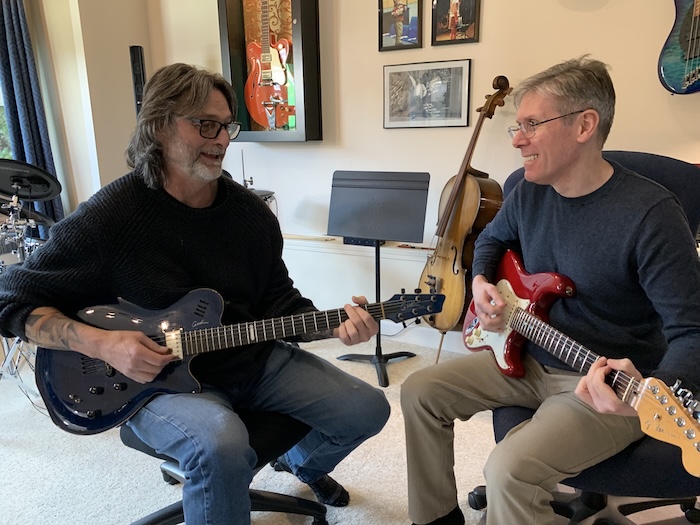
Why You Should Take Adult Guitar Lessons
Have you ever thought, “I’d love to learn guitar, but am I too old to start?”
Maybe you’ve always wanted to play but never had the time. Maybe you played guitar years ago and want to pick it up again. Or perhaps you’ve reached a point in life where you’d like to learn something just for yourself.
The good news is simple: you are never too old to learn guitar.
Adult guitar lessons can be about much more than learning chords and songs. Learning an instrument challenges your brain, gives you a creative outlet, provides a reason to slow down and can even introduce you to new people.
At Upbeat Music Academy in Glenmore, Kelowna, adult students learn guitar at all different experience levels. Some are complete beginners. Others are returning to guitar after decades away.
Here are some of the reasons learning guitar as an adult can be so rewarding.
1. Is It Too Late to Learn Guitar as an Adult?
No.
One of the biggest misconceptions about learning an instrument is that you have to start as a child.
Children do have advantages when learning certain skills, but adults bring plenty of advantages of their own. You already understand how to practise, solve problems and work toward a goal. You also have years of musical experiences and favourite songs that can make learning more meaningful.
And perhaps most importantly, you get to choose why you’re learning.
You don’t have to prepare for an exam or become a professional musician.
Maybe you simply want to play your favourite songs.
That’s a perfectly good reason.
2. Can Adults Learn Guitar Quickly?
Adults often surprise themselves with how quickly they can begin playing.
You don’t need to learn hundreds of chords before you can make music. A handful of useful chords, a basic strumming pattern and a song you enjoy can be enough to get started.
As your skills develop, you’ll gradually add:
- More chords
- Scales
- Picking techniques
- Rhythm skills
- Music theory
- Guitar solos
- Improvisation
- Songwriting
The important thing is to build your skills in manageable steps rather than trying to learn everything at once.
3. Can Learning Guitar Help Keep Your Brain Active?
This is one of the most interesting reasons for adults to learn an instrument.
Playing guitar combines listening, memory, movement, timing, concentration and decision-making.
You might be reading a chord diagram while remembering the next chord, moving your fingers into position and keeping time with your picking hand—all at once.
That’s a lot for your brain to coordinate.
Research into musical training has found that learning an instrument is associated with changes in brain structure and function, a process often described as neuroplasticity. Studies of older adults have also found promising evidence that instrumental training can improve certain cognitive and motor abilities, although researchers are still working to understand exactly how large and lasting these benefits are.
So you don’t have to think of guitar practice as a brain workout.
You’re simply learning something challenging—and your brain has to adapt along the way.
4. Can Guitar Help With Stress?
For many adults, guitar becomes a welcome break from work, responsibilities and screens.
When you’re concentrating on a song, your attention is focused on something tangible. You’re listening to the rhythm, moving your hands and thinking about what you’re playing rather than everything else going on around you.
Research into music and wellbeing has found connections between musical engagement and mood, stress, social connection and overall wellbeing. A large Canadian study published in 2024 also found that more frequent musical practice was associated with better wellbeing and mental health, particularly among amateur musicians.
That doesn’t mean guitar lessons are a treatment for stress or mental health problems.
But having something enjoyable to look forward to each week can be valuable.
5. What If I Have No Musical Experience?
That’s completely fine.
You don’t need to know how to read music.
You don’t need to know what a chord is.
You don’t need to understand scales.
And you certainly don’t need to be “naturally musical.”
A good beginner guitar lesson should start where you are.
You can learn the fundamentals gradually while playing music that actually interests you.
For some adults, that might mean classic rock.
For others, it’s blues, folk, pop, country or singer-songwriter music.
There isn’t one correct way to learn guitar.
6. Can Guitar Improve Coordination?
Try changing from one chord to another while keeping a steady rhythm.
It sounds simple.
It isn’t.
Your fretting hand and picking hand have completely different jobs, and your brain has to coordinate them precisely.
Over time, practising these movements helps develop greater control and familiarity. Research into instrumental training has found improvements in certain motor and visuomotor abilities in older adult learners, suggesting that learning an instrument can remain a valuable form of skill development later in life.
And unlike many exercises, guitar practice has a pretty great reward at the end:
You get to hear the result.
7. Can Adults Learn Guitar for Creativity and Self-Expression?
Absolutely.
This is one of the things that can get overlooked when people talk about learning an instrument.
You aren’t simply learning where to put your fingers.
Eventually, you can start making your own musical decisions.
You can change the rhythm of a song.
Create your own riffs.
Improvise a solo.
Write lyrics.
Compose music.
Or simply play a chord progression and see where it takes you.
Guitar gives you a way to express ideas and emotions without necessarily having to put them into words.
And the older you are, the more life experience you have to draw from.
8. Can Learning Guitar Help Adults Connect With Other People?
Guitar doesn’t have to be a solitary hobby.
You can play with your partner, children, friends or other musicians.
You can accompany someone singing.
You can join a band.
You can jam with other guitarists.
Or you can simply bring a guitar to a gathering and play a few songs.
Music has a remarkable ability to bring people together. Research on music-making consistently points to social connection and belonging as important parts of the musical experience. Canadian research has also found associations between musical practice, social support and wellbeing.
You don’t have to be an amazing guitarist to enjoy making music with other people.
What If My Fingers Hurt When I Start Playing Guitar?
This is a very common concern for adult beginners.
If you’re playing a steel-string acoustic guitar, your fingertips may feel uncomfortable when you’re first learning. Your hands are simply not used to pressing strings against the fretboard.
Fortunately, this generally gets easier as you become accustomed to playing.
A good teacher can also help you avoid unnecessary tension and show you how to position your fingers properly.
And if finger comfort is a major concern, an electric guitar can sometimes be an easier place to start because the strings can require less pressure than many acoustic guitars.
The important thing is not to push through significant pain.
What If I Don’t Have Much Time to Practise?
You don’t need to spend hours every day playing guitar.
For a busy adult, regular practice is usually more useful than occasional marathon sessions.
Even 10–15 focused minutes can be productive.
You might spend one day working on chord changes and another playing through a favourite song.
As your schedule allows, you can gradually increase your practice time.
The goal isn’t to add another obligation to your life.
The goal is to find a sustainable routine that you actually enjoy.
Should Adults Learn Acoustic or Electric Guitar?
There isn’t a universal answer.
Choose acoustic guitar if you like the idea of picking up your instrument and playing without an amplifier. Acoustic guitar works particularly well for folk, singer-songwriter music, country and many pop songs.
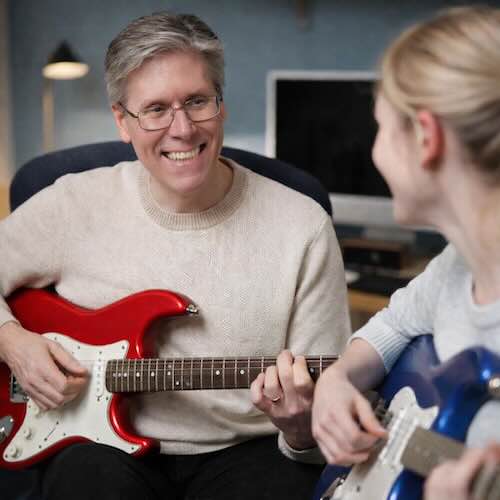
Choose electric guitar if you love rock, blues, metal, indie or lead guitar. Electric guitar can also be physically comfortable for some beginners because of its lighter strings and easier string bending.
And you don’t have to make a permanent decision.
Many guitarists eventually play both.
Is It Worth Taking Private Guitar Lessons as an Adult?
You can certainly learn guitar from books, videos and online courses.
But private lessons offer something those resources can’t always provide: another musician listening to you play and knowing what you should work on next.
An experienced teacher can help you:
- Choose an appropriate guitar
- Learn proper technique
- Avoid frustrating habits
- Understand chords and scales
- Learn songs you actually enjoy
- Practise more efficiently
- Work through difficult sections
- Develop your own musical interests
Perhaps the biggest advantage is that your lessons can be built around you.
Your age, experience, musical taste, schedule and goals all matter.
Adult Guitar Lessons in Glenmore, Kelowna
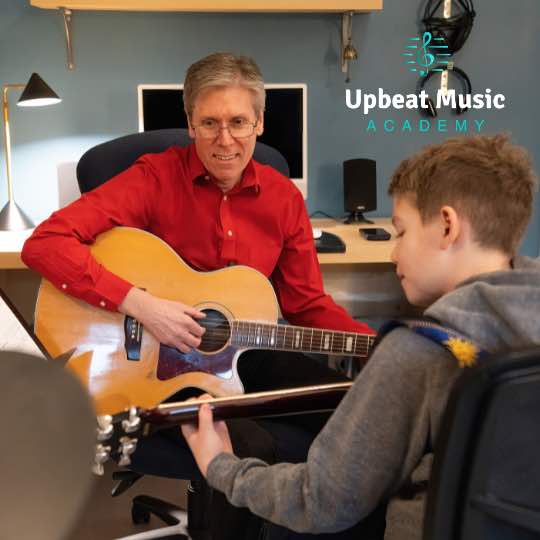
At Upbeat Music Academy in Glenmore, Kelowna, Noel Wentworth offers private guitar lessons for adults, including complete beginners and students returning to guitar after time away.
Noel has more than 25 years of teaching experience and decades of experience as a guitarist and musician.
Lessons can include acoustic or electric guitar, depending on what you want to learn.
You might want to learn:
- Your favourite songs
- Rock and blues guitar
- Acoustic guitar
- Electric guitar
- Guitar solos
- Chords and rhythm
- Scales and improvisation
- Music theory
- Songwriting
- Better technique
There is no requirement to become an expert.
You don’t have to perform on stage.
And you certainly don’t have to become the next guitar hero.
You just need to want to play.
Is Learning Guitar as an Adult Worth It?
For many adults, the answer is an easy yes.
You gain a new skill, challenge your brain, make time for creativity and have something enjoyable to work toward.
And unlike many hobbies, guitar is something you can continue enjoying for decades.
You can play alone in your home, with friends, with your family or with other musicians.
So if you’ve been telling yourself that you’ll learn guitar “someday,” maybe someday has arrived.
It’s never too late to pick up a guitar.
– With over 25 years of teaching experience, Noel Wentworth offersGuitar lessons in Kelowna at theUpbeat Music Academy Kelowna. You can contact him here

About the Author: noelwentworth