
Have you ever wondered why playing guitar feels so satisfying?
There is more going on than simply moving your fingers across the strings.
When you play guitar, you’re listening, remembering, concentrating, coordinating both hands and making decisions about what to play next. Add in creativity, rhythm and expression, and you’ve got an activity that gives your brain plenty to work on.
So, what actually happens when you learn guitar?
Does Playing Guitar Improve Your Brain?
Learning guitar can be a surprisingly complex mental workout.
Even playing a simple song requires your brain to coordinate several things at once:
- Reading notes or chord diagrams
- Remembering chord shapes
- Moving your fingers accurately
- Controlling your picking or strumming hand
- Keeping a steady rhythm
- Listening to what you’re playing
- Remembering what comes next
As you practise, your brain adapts to these demands. This ability to change and adapt through learning is called neuroplasticity.
Research on musicians has found differences in brain structure and connectivity associated with musical training. However, it’s important not to overstate the research. Learning guitar isn’t a magic way to make you smarter.
Instead, think of it as learning a challenging new skill that exercises several different mental and physical abilities at the same time.
Can Learning Guitar Improve Memory?
Absolutely—memory is a big part of playing guitar.
As you learn, you gradually remember:
- Chords
- Scales
- Songs
- Riffs
- Finger positions
- Rhythms
- Musical patterns
You also use working memory, which allows you to hold information in your mind while you’re doing something else.
For example, you might be playing a chord while remembering that you need to change to another chord on the next beat.
As you become more experienced, many of these movements become automatic. You don’t have to consciously think about every finger position anymore.
That’s one of the satisfying parts of learning an instrument: something that once seemed difficult eventually becomes second nature.
Does Guitar Help With Concentration?
Learning guitar requires you to pay attention.
When you’re learning a new riff, you need to concentrate on the notes, rhythm, timing and movement of your hands.
Lose focus and you might:
- Play the wrong note
- Miss a chord change
- Lose the rhythm
- Pick the wrong string
- Forget where you are in the song
With practice, you gradually learn to manage more information at the same time.
Eventually, you may be able to play a familiar song while thinking about your tone, dynamics, phrasing or what you want to play next.
This is one reason learning guitar can be such a rewarding challenge.
Why Is Guitar Good for Coordination?
Try playing a simple chord.
Your fretting hand has to position several fingers correctly while your other hand strums or picks the strings at exactly the right time.
Now change chords while keeping the rhythm going.
It’s harder than it looks!
Guitar develops fine motor coordination because your hands have different jobs to do at the same time.
Your fretting hand controls pitch and chord shapes.
Your picking hand controls rhythm, attack and articulation.
Your brain has to coordinate everything.
With regular practice, these movements become smoother and more natural.
Why Does Playing Guitar Feel So Rewarding?
One of the best things about learning guitar is that you can actually hear your progress.
The first time you successfully change between two chords feels good.
The first time you play an entire song feels even better.
And finally mastering a riff you’ve been struggling with for weeks?
That’s a great feeling.
Music engages brain systems involved in reward and emotion, which helps explain why both listening to and making music can be so enjoyable.
There’s also something uniquely satisfying about learning a piece of music that once seemed impossible and eventually being able to play it yourself.
Does Playing Guitar Reduce Stress?
For many people, playing guitar is a great way to take a break from everyday life.
When you’re focused on playing, your attention is directed toward the music.
You’re listening.
You’re playing.
You’re thinking about rhythm and timing.
For some people, that provides a welcome break from work, school, phones and other daily distractions.
Music can influence mood and emotional state, and playing an instrument can provide a creative outlet.
Of course, guitar lessons aren’t the same thing as music therapy. But learning an instrument can still be an enjoyable and rewarding part of a healthy lifestyle.
Can Playing Guitar Help You Connect With Other People?
This is one of the best things about learning guitar.
You don’t have to play alone.
You can play with:
- Friends
- Family
- Other guitarists
- Singers
- Bands
- Jam groups
You can play around a campfire, join a band, accompany someone who sings or simply play a song for your family.
Making music together creates a shared experience.
Research into group music-making has found evidence that making music with other people can promote social connection and bonding.
And you don’t have to be an expert.
Sometimes three chords and a good song are all you need.
Why Does Guitar Sound So Different From Other Instruments?
Another fascinating part of guitar is the amount of control you have over the sound.
You can bend a note.
Add vibrato.
Slide between notes.
Mute the strings.
Pick softly.
Pick aggressively.
Change your amplifier settings.
Add effects such as delay, reverb, distortion or chorus.
Two guitarists can play exactly the same notes and still sound completely different.
That’s part of what makes guitar such an expressive instrument.
How Does an Electric Guitar Actually Make Sound?
There’s some interesting physics behind an electric guitar.
When a guitar string vibrates over a magnetic pickup, the movement of the metal string changes the magnetic field around the pickup.
The pickup converts that movement into a small electrical signal.
The signal travels to an amplifier, which increases it before sending it to a speaker.
The speaker then converts the electrical signal back into sound.
That’s how the vibration of a relatively small guitar string can eventually become the huge sound of an electric guitar.
And once you add effects and amplification, the possibilities become almost endless.
Does Guitar Help With Creativity?
Learning guitar isn’t just about reproducing songs.
Once you understand some basic chords, scales and rhythms, you can start experimenting.
You can change a chord progression.
Write your own riff.
Make up a melody.
Improvise a solo.
Write a song.
Or simply play around and see what sounds good.
This is where guitar becomes more than a technical skill.
You’re making musical decisions and expressing your own ideas.
Do You Have to Be Naturally Musical to Learn Guitar?
No.
You don’t need to be born with a special musical talent to learn guitar.
Some students pick things up quickly.
Others need more time and repetition.
That’s completely normal.
Good guitar playing comes from learning the fundamentals, practising regularly and gradually building your skills.
You don’t need to become the next guitar hero.
You just need to start.
Can Guitar Lessons Help You Learn Faster?
You can certainly teach yourself guitar.
There are thousands of videos, tutorials and online resources available.
But having a good guitar teacher can make the process much easier.
A teacher can:
- Show you proper technique
- Help you avoid bad habits
- Explain things that don’t make sense
- Choose exercises appropriate for your level
- Help you learn songs you actually enjoy
- Keep you moving forward when you get stuck
Perhaps most importantly, a teacher can help you figure out what to practise next.
Learning Guitar in Kelowna
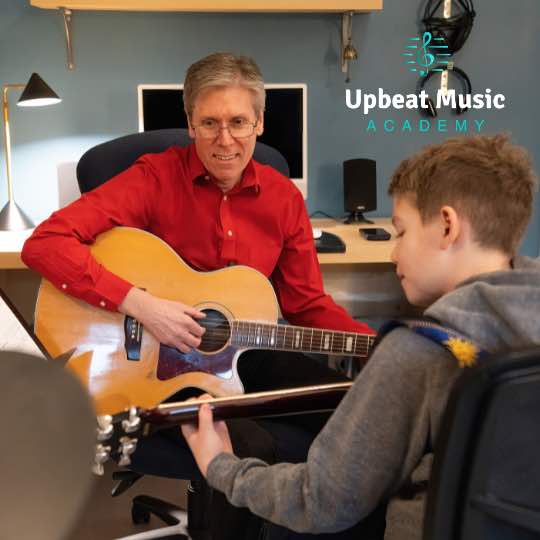
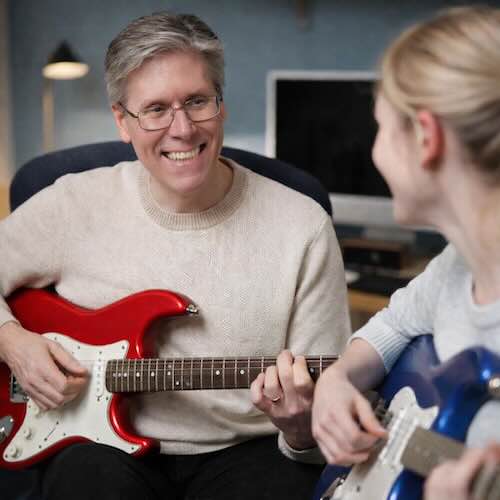
At Upbeat Music Academy in Glenmore, Kelowna, Noel Wentworth teaches guitar, bass and ukulele to students of different ages and experience levels.
Noel has more than 25 years of teaching experience and decades of experience as a musician.
Lessons can be adapted to what you want to learn.
You might want to:
- Learn acoustic guitar
- Play electric guitar
- Learn your favourite songs
- Play rock, blues or pop
- Improve your rhythm
- Learn guitar solos
- Understand scales and music theory
- Learn to improvise
- Write your own music
The fundamentals are important, but guitar lessons should also be enjoyable.
After all, the best reason to learn guitar is usually pretty simple:
You want to play.
So, Why Is Playing Guitar So Good for You?
Playing guitar brings together a surprising number of skills.
You’re using your:
Brain to remember and make decisions.
Eyes to read music or watch what you’re playing.
Ears to listen and respond.
Hands to coordinate complicated movements.
Creativity to make musical choices.
And sometimes, you’re using all of those things while playing with other people.
That’s what makes guitar such a fascinating instrument.
It’s not just about learning chords and songs.
It’s about developing a skill, expressing yourself, connecting with other people and—most importantly—having fun while you do it.
– With over 25 years of teaching experience, Noel Wentworth offers Guitar lessons in Kelowna at the Upbeat Music Academy Kelowna

About the Author: noelwentworth