
Could learning guitar actually make you feel better?
It might.
Most people don’t start guitar lessons because they’re thinking about their emotional wellbeing. They usually want to play their favourite songs, learn a new skill, join a band, write music or simply do something they’ve always wanted to try.
But learning an instrument can offer something beyond the music itself.
It gives you time to focus, create, listen, practise and express yourself. For many people, having a regular creative activity can become an enjoyable and meaningful part of their lives.
Research into active music-making has found associations with psychological and social wellbeing, although the evidence isn’t as simple as saying that playing an instrument automatically improves mental health. Studies have looked at many different kinds of musical activities, and researchers continue to investigate exactly how and why making music affects wellbeing.
So what can guitar bring to your everyday life?
Can Playing Guitar Help Reduce Stress?
For many guitarists, picking up the guitar is a chance to step away from everything else for a while.
When you’re learning a chord progression or working out a song, your attention naturally shifts toward what you’re hearing and what your hands are doing.
You have to listen.
You have to concentrate.
You have to stay in time.
For a little while, the emails, deadlines and other distractions can wait.
Music research has found connections between musical participation and wellbeing, including areas such as stress, mood and emotional wellbeing. However, the effects vary between individuals and activities, so it’s better to think of guitar as one enjoyable way to support your overall wellbeing, rather than as a treatment for stress or a mental health condition.
Why Does Playing Music Feel So Good?
There’s something satisfying about creating a sound yourself.
Listening to your favourite song is enjoyable, but playing the chords yourself is a different experience.
You aren’t just hearing the music.
You’re making it.
You might spend a week struggling with a chord change and then suddenly play it smoothly.
You might finally learn a guitar riff you’ve been trying to figure out.
You might play an entire song without stopping for the first time.
Those small accomplishments can be genuinely rewarding.
Can Learning Guitar Improve Your Mood?
It can be a positive part of your routine.
Music gives you an opportunity to do something creative and enjoyable, and research has found associations between musical engagement and emotional wellbeing. A 2023 systematic review and meta-analysis, for example, found evidence that active musical participation can benefit psychosocial functioning, although the studies varied considerably.
You don’t need to be an exceptional guitarist to get something out of playing.
You don’t even need to perform for anyone else.
Sometimes playing your guitar for 15 minutes after a long day is enough to give yourself a break and do something you enjoy.
Does Guitar Practice Help with Focus?
Learning guitar requires attention.
Even a simple song involves several things happening at once:
- Remembering chords
- Changing between chord shapes
- Keeping a steady rhythm
- Listening to your timing
- Reading music or chord charts
- Coordinating both hands
- Remembering where you are in the song
As you become more experienced, you can add even more layers, such as improvisation, ear training and playing along with other musicians.
The result is an activity that encourages you to be present and engaged.
Can Guitar Be a Good Hobby for Adults?
Absolutely.
You don’t have to start learning guitar as a child.
In fact, many adults discover guitar because they’re finally making time for something they’ve always wanted to do.
Maybe you’ve had a guitar sitting in the closet for years.
Maybe you played when you were younger and want to start again.
Maybe you’ve never touched a guitar before.
There is no age limit on learning an instrument.
And you don’t have to turn it into a career.
Learning guitar can simply be something you do because you enjoy it.
Can Learning Guitar Give You a Sense of Accomplishment?
One of the best things about learning guitar is that progress is often easy to see.
Think about the difference between your first guitar lesson and where you might be six months later.
At first, simply getting a chord to sound clean can be a challenge.
Then you learn to change between two chords.
Then three.
Eventually, you’re strumming through an entire song.
These small achievements add up.
Having something you can work toward—and eventually accomplish—can make learning guitar especially rewarding.
Can Guitar Help with Creativity?
Definitely.
Once you learn some basic guitar skills, the instrument becomes much more than a way to reproduce other people’s songs.
You can start experimenting.
Change a chord.
Write a melody.
Make up a riff.
Try a different rhythm.
Put some lyrics together.
Record an idea on your phone.
You don’t need to consider yourself a songwriter to experiment with music.
Creativity is part of the fun.
Can I Use Guitar to Express My Emotions?
Music can be a powerful way of expressing things that are sometimes difficult to put into words.
A slow chord progression can feel reflective.
A loud distorted guitar can sound energetic and aggressive.
A simple acoustic melody can feel calm or intimate.
You can also write your own music and use melodies, chords and lyrics to express your experiences.
Research into participatory music-making has identified emotional expression, self-development, respite and social connection as some of the ways people describe music as supporting their wellbeing.
That doesn’t mean every guitar lesson will produce a profound emotional experience.
Sometimes you’re just learning a D chord.
And that’s perfectly fine too.
Can Playing Guitar Help You Connect with Other People?
This may be one of the most enjoyable parts of learning an instrument.
You can play guitar with:
- Friends
- Family
- Other musicians
- A band
- A singer
- Your teacher
- Other students
You can learn songs together, jam, perform or simply sit around and play.
Music can create social connections that don’t necessarily happen through everyday conversation.
Research on music participation has found links between musical activity and social wellbeing, particularly when people make music together.
Do You Have to Perform to Get the Benefits of Playing Guitar?
Not at all.
Some guitarists love performing.
Others would rather play alone in their living room.
Both are perfectly valid.
You don’t need an audience to enjoy playing music.
If performing makes you nervous, there’s no reason to rush into it. You can build your confidence gradually by playing for yourself, then perhaps for a family member or friend.
And if you eventually decide you’d like to perform, guitar lessons can help you develop the skills and confidence to do that too.
What If I’m Too Busy to Learn Guitar?
You don’t need hours of free time.
A short, focused practice session can still be worthwhile.
Even 10–15 minutes can give you an opportunity to work on a chord progression, practise a song or simply play.
The key is finding a routine that fits your life.
If you wait for the perfect two-hour block of free time, you may never get around to playing.
Instead, make guitar something you can realistically fit into your week.
Can Guitar Lessons Be a Healthy Break from Screens?
For many people, learning an instrument provides a welcome change from phones, computers and streaming.
Instead of consuming content, you’re creating something.
Instead of scrolling, you’re practising.
Instead of watching someone else play guitar, you’re learning how to play it yourself.
That doesn’t mean guitar needs to replace all your screen time.
But having a creative activity that gets you away from a screen can be a refreshing change.
Is Learning Guitar a Form of Therapy?
This is an important distinction.
Guitar lessons are not therapy, and a guitar teacher is not a therapist.
Music can certainly be meaningful and may support wellbeing, but that is different from professional music therapy or mental health treatment.
Research into music and wellbeing is promising, but findings vary depending on the activity, the people involved and how wellbeing is measured. A recent systematic review found positive, mixed and no-effect results across different types of musical participation. It also noted that much of the research has focused on singing rather than playing instruments.
If you’re dealing with significant anxiety, depression or another mental health concern, guitar can be a positive hobby to enjoy alongside appropriate professional support—but it shouldn’t be considered a replacement for that support.
What If I Don’t Think I’m Musical?
You don’t need to be.
You don’t need perfect rhythm.
You don’t need to know how to read music.
You don’t need to have played another instrument.
And you certainly don’t need to be able to sing.
These are skills that can be developed.
Your first guitar lesson isn’t supposed to sound like a concert.
It’s supposed to be the beginning of learning.
Can Guitar Lessons Be Fun Even If I’m a Complete Beginner?
Absolutely.
In fact, beginners often experience some of the most noticeable progress.
Your first goal might simply be learning how to hold the guitar and play a clear chord.
Then you might learn a few more chords and discover that you can already play part of a song.
As your skills develop, you can choose where you want to go next.
Maybe you’ll discover a love of acoustic guitar.
Maybe you’ll want to play electric guitar.
Maybe you’ll become interested in blues, rock, pop, fingerstyle or songwriting.
There is plenty of time to figure that out.
How Can Guitar Become Part of My Wellbeing Routine?
You don’t need to make guitar practice complicated.
Try making it a small, enjoyable part of your week.
Put your phone away for 15 minutes.
Pick up your guitar.
Play a song you enjoy.
Work on something you’ve been trying to learn.
Experiment with a new chord.
Or just play.
The goal isn’t to turn guitar into another task on your to-do list.
The goal is to have something you look forward to doing.
Learn Guitar in Kelowna
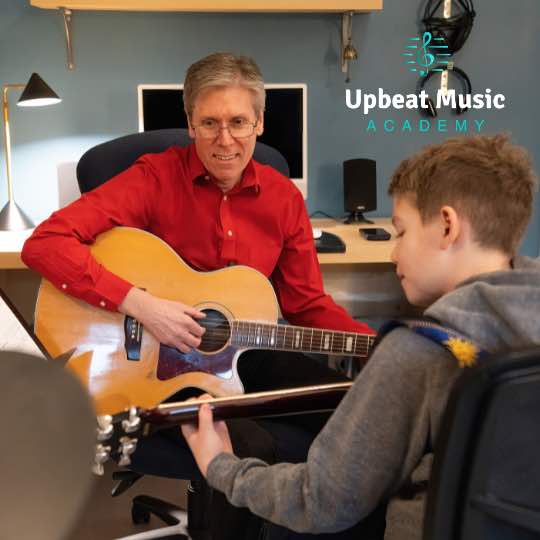
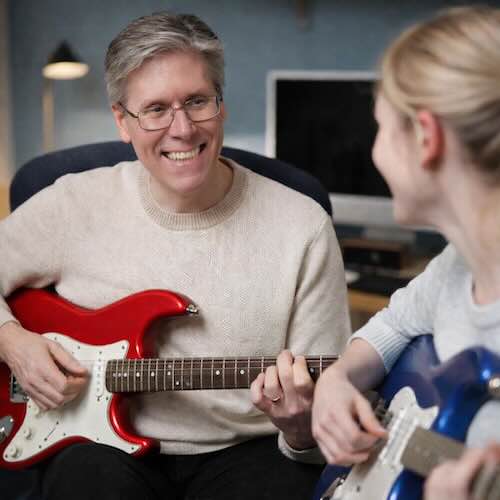
At Upbeat Music Academy in Glenmore, Kelowna, guitar lessons are designed to be both educational and enjoyable.
Whether you’re a complete beginner, returning to guitar after many years, or looking to take your playing further, lessons can be tailored to your interests and goals.
You can learn acoustic or electric guitar, work on your favourite songs, develop your technique, explore music theory, learn guitar solos, improvise or even start writing your own music.
Noel Wentworth has been teaching guitar in Kelowna for more than 25 years.
The goal isn’t simply to teach you how to play guitar.
It’s to help you develop a skill you can enjoy for years to come.
Because sometimes the best part of learning guitar isn’t becoming a better guitarist.
It’s simply having something you love to do.
– With over 25 years of teaching experience, Noel Wentworth offers Guitar lessons in Kelowna at the Upbeat Music Academy Kelowna

About the Author: noelwentworth